Code: 10176
Dimensions:
ANONYMOUS ITALIAN Rome 1574
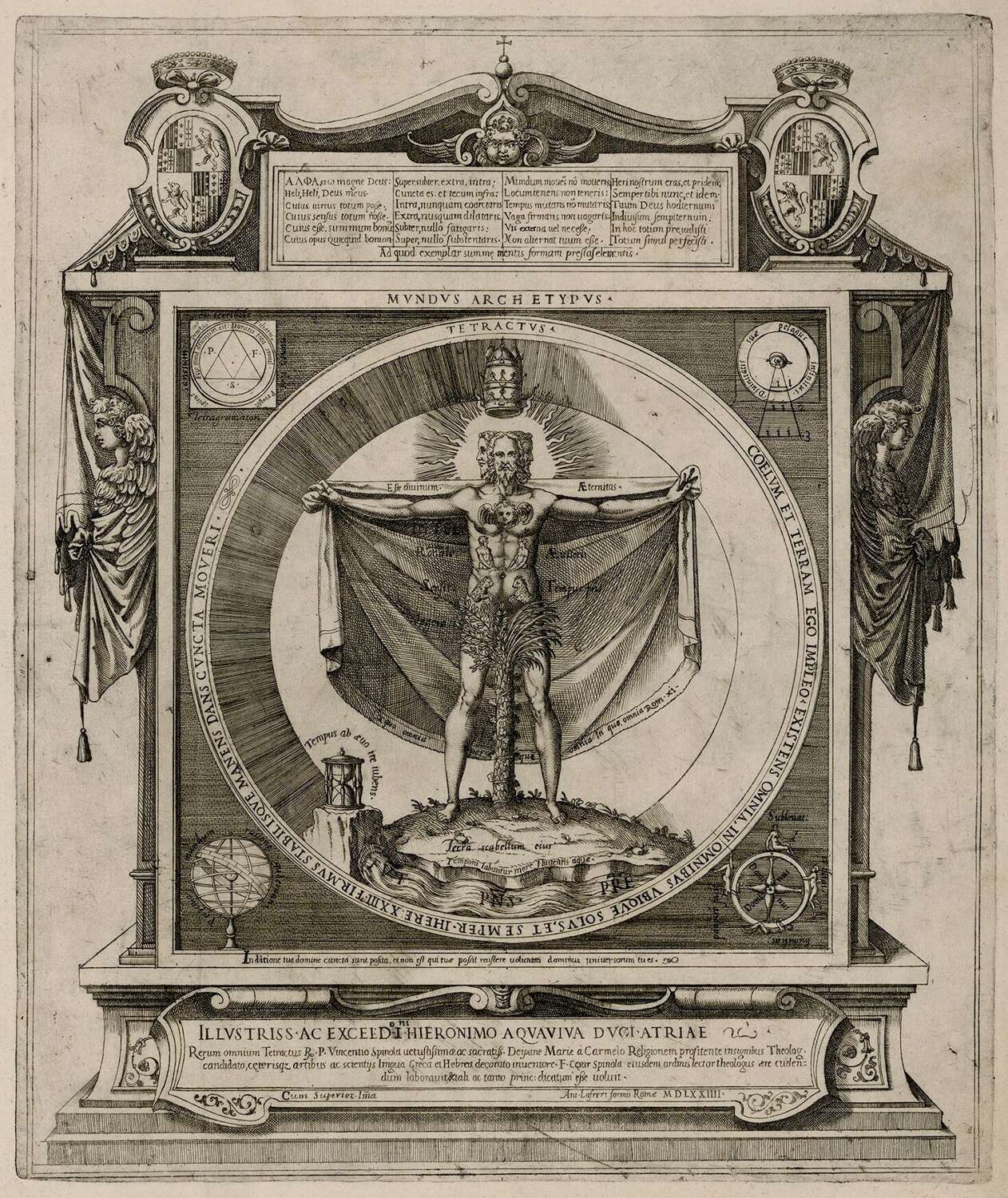
Mundus Archetypus.
Etching and engraving, published by Antonio Lafrery; 1574. A very fine impression in fine condition with margins; some tears and stains in the large margins; old vertical and horizontal creases, visible chiefly verso. Apparently of the greatest rarity, and possibly the second known impression. We know only one other impression in public collections, in Madrid at the Biblioteca Nacional (ER/1284, tav.265). In the cartouche at the bottom, the print is dedicated to Gian Girolamo Acquaviva I (1521-1592), Count of Conversano and 10th Duke of Atri who may well have commissioned the engraving.
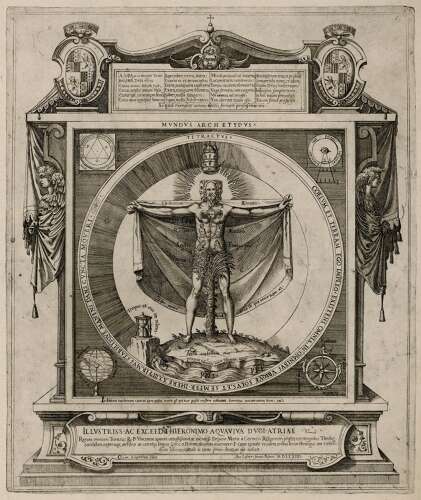
The subject, a nude man with outstretched arms, clearly relates to the Vitruvian ideal of human proportion as the model of the perfection of the universe. While a connection to Leonardo’s famous drawing of the Vitruvian Man is tempting but uncertain, an indirect connection is possible in the work of Leonardo’s learned friend and contemporary Fra Luca Pacioli who published in 1509 his De Divina Proportione. Pacioli was very much aware of Leonardo’s interest in Vitruvian measure and proportion, even if is not possible to find absolute evidence of Pacioli’s knowledge of Leonardo’s drawing. By the first years of the 16th century the first images of the Vitruvian Man had appeared in printed books and these illustrations may have formed a loose connection between Leonardo and our sheet.
The deeply secular subject of our print must have come perilously close to religious heterodoxy at this time, even if a papal tiara appears above the head of the man. A number of Latin inscriptions populate the image, apparently relating to the central theme. The inscription around the circle, clearly referring to the man with outstretched arms, may be translated as “I fill Heaven and Earth existing in all things alone everywhere and always,” an idea that seems clearly related to a Vitruvian idea of human proportions as a paradigm of the order of the universe. Other inscriptions, often in very abbreviated form, inhabit the image. Precise decipherment and translations, we believe, will confirm our reading of the import of our engraving.
The torso of the figure, however, is filled with symbolic forms, animal and human. His genitals are hidden by a flowing palm tree and the upper hem of the garment he holds is labelled “ temporal” and “eternal”; his head or rather his three faces suggest past present and future; the seraph on his chest suggests his divine nature or at least his connection to the divine. The symbols, however, resist definition in specifically Catholic terms. The palm tree, may well be a generalized symbol of regeneration and eternal life, but Catholic symbolism employs only the palm frond as a symbol of martyrdom, and the placement of the palm tree as a kind of cache-sexe, would have been extremely unusual in Christian thought.
The three faces of the figure present even more serious problems for interpretation in traditional Christian iconographic terms. They can scarcely fit with orthodox Trinitarian symbolism of God the Father, Christ and the Holy Spirit, and can even be read as a vision of evil in Dantean terms in which the devil had three faces as a mockery of God.
The figures on the torso, male and female, lion and lamb, suggest that humanity contains a union of opposites, this duality, however, is not expressed in terms of recognizable Christian iconography.
These passages of the engraving make our figure a representation of an anthropocentric universe which the Church surely would have seen as confusing human activity with that of God, or worse, constituting attributes only with difficulty connected to Catholic dogma. It is unclear as to the sources of the ideas pictured in this sheet, but the heterodox suggestions of human eternality and universal centrality may have been sufficiently disturbing that the sheet was suppressed or derided by Roman authorities, thus accounting for its exceptional rarity.
436 x 363 mm 17 3/16 x 14 ¼ inches
Sheet: 505 x 407 mm 19 7/8 x 16 inches
Note: Cited by Carmen Bambach in Leonardo da Vinci Rediscovered, 2019, New Haven, Vol. II, p.236. The earliest illustrated edition of Vitruvius is Giovanni Giocondo de Verona, De Architectura (M Vitruvius per Iocondum solito castigator factu cum figuris et tabula,), Venice 1511