Code: 10173
Dimensions:
FRANCESCO PIRANESI Rome 1758/59 – 1810 Paris
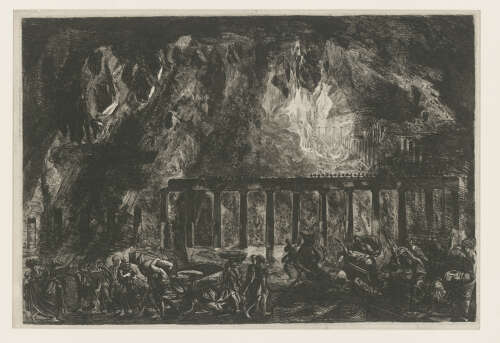
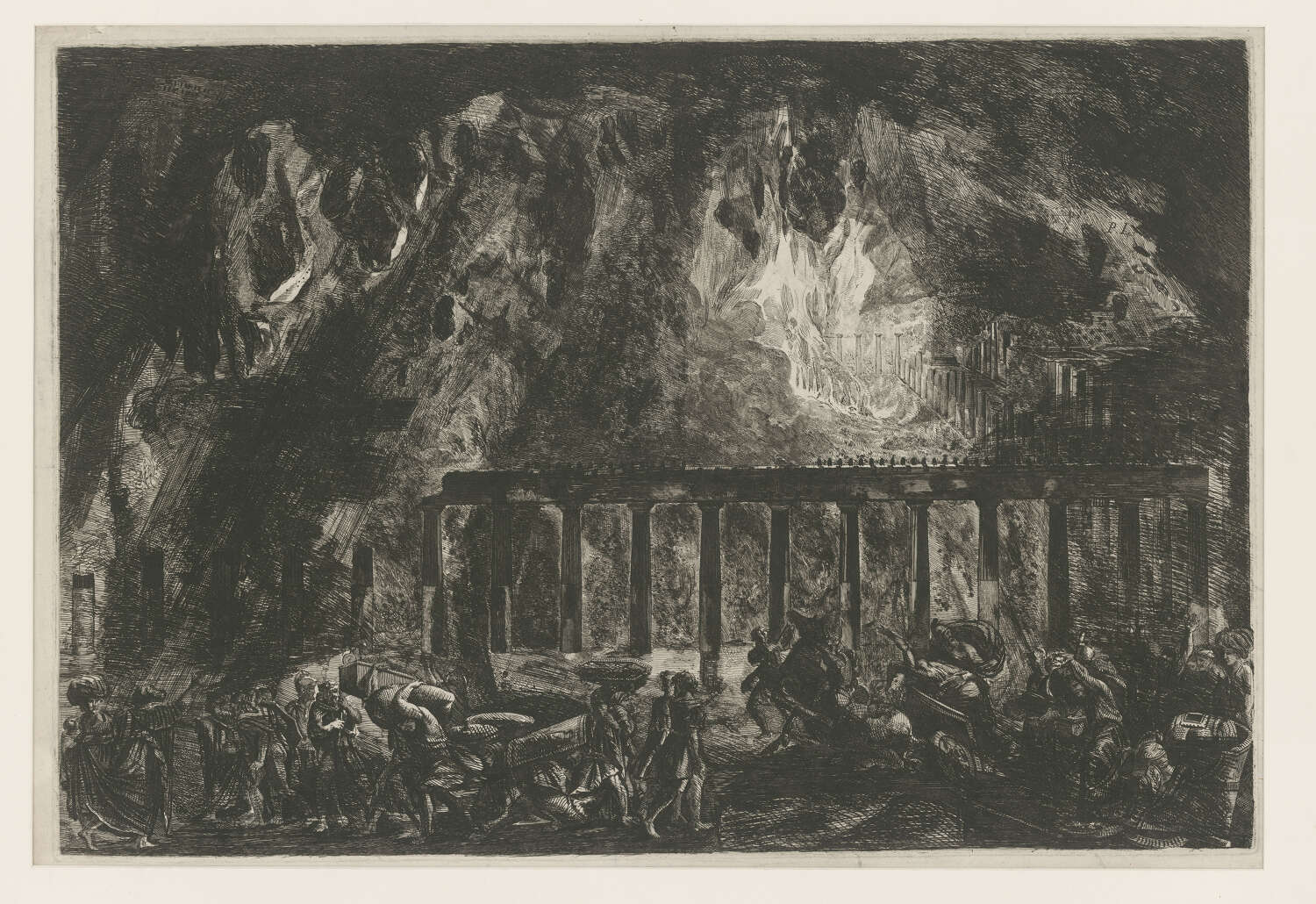
The Burning of the Temple of Jupiter and the Destruction of Pompeii.
Etching and engraving, the frontispiece of his Antiquités de Grande Grèce, 1804. Focillon p. 68.
A brilliant impression on laid paper without visible watermark, in excellent, fresh condition, with 25-35 mm margins all around; several closed marginal tears, not affecting the image.
Francesco became his father’s chief assistant in the extremely active Piranesi publishing house, and surely accompanied his father to Pompeii and Herculaneum as early as 1770, but certainly before Giovanni-Battista’s death in 1778. From 1783 Francesco worked for King Augustus III of Sweden, first as the king’s commercial agent and in association with Louis-Antoine Desprez who had also attracted the attention of the Swedish king. Francesco produced a series of powerful views of Rome and its environs in line etching to which Desprez added watercolor with great virtuosity.
Francesco was involved in French Republican political activities in Rome. After the French military commandant in Rome surrendered to the English, Francesco moved the Piranesi firm with all of the Piranesi copper printing plates to Paris in 1799.
Francesco’s oversize Burning and Destruction of the Temple of Jupiterhas long been recognized as the artist’s graphic masterpiece. The plate, so heavily worked with passages of deep black alternating with brilliant light, must have caused Francesco some effort to create the final form of this giant sheet. We know of at least one trial proof, before much of the vigorous, heavy shading in the area above the entablature of the temple, with us in 2019, and now at the Rijksprentenkabinet, Rijksmuseum, Amsterdam. This concentration of heavy shading in the finished plate must also have posed serious challenges for effective, nuanced printing.
Although the vigorously reworked later states of his father’s Carceri with their powerful contrasts of light and dark must have influenced Francesco, this etching is entirely his own creation. His overwhelming sense of drama and the vast scale of the etching rivals the energy of his father’s late etchings and represents one of the most powerful expressions of destruction in Antiquity.
825 x 935 mm 32 ½ x 36 13/16 inches
Note: The Temple was severely damaged in the earthquake of the year 62; repairs were underway when the volcanic eruption of 79 destroyed Pompeii.