Code: 10131
Dimensions:
DOMENICO CRESTI called PASSIGNANO Passignano 1559 – 1638 Florence
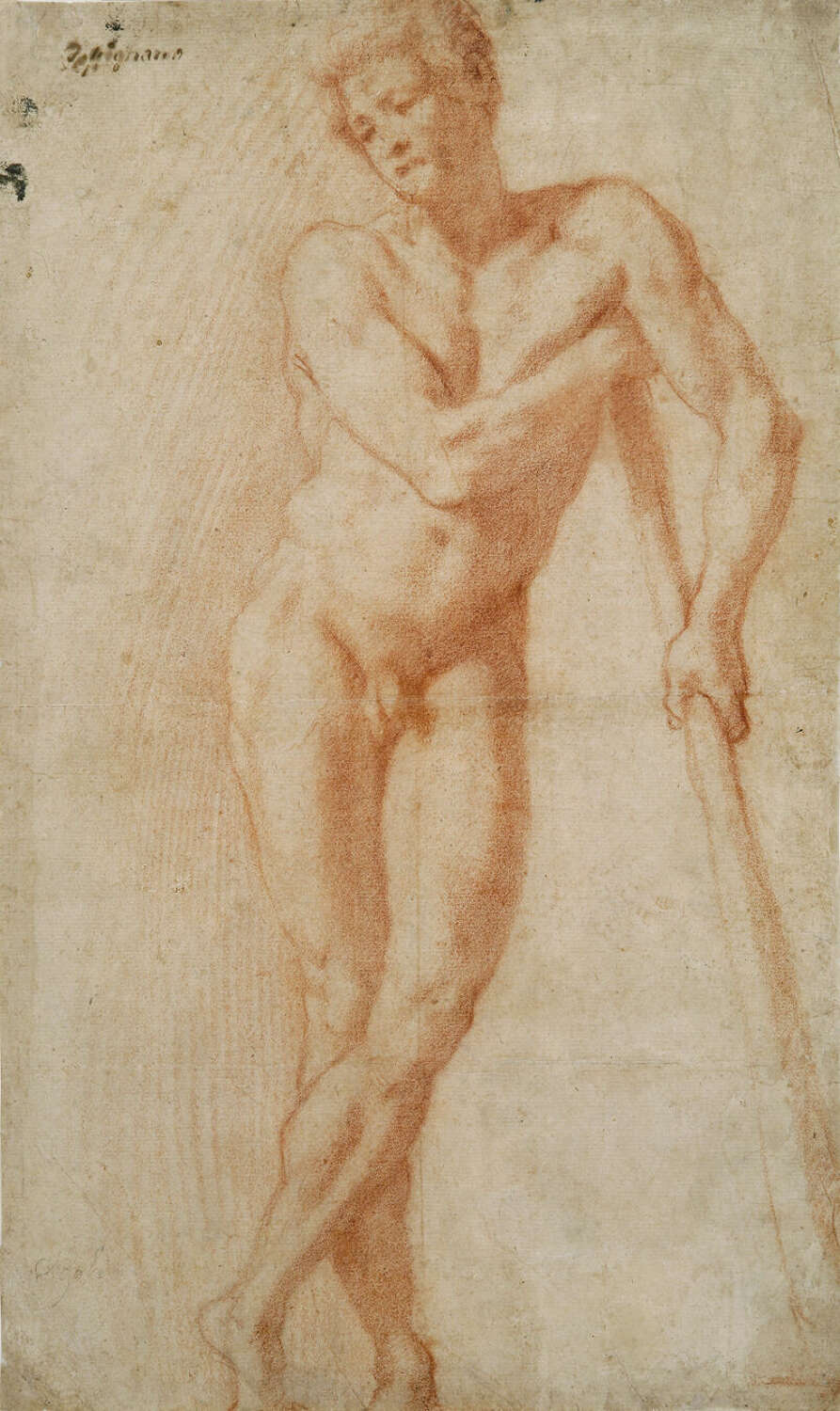
A Male Nude in Imitation of the Farnese Hercules.
Drawing in red chalk, inscribed in a contemporary hand upper left: Passignano.
Passignano is another of the group of distinguished painters who determined the course of Florentine art from the last quarter of the sixteenth century through the first quarter of the seventeenth century, when Florentine art made the transition from late Mannerism to early Baroque. As with all of these painters, drawing formed an integral part of their approach to their art.
Passignano began his career as a student with Girolamo Macchietti and then Giovanni Battista Naldini. The chief influence on the young artist was Federico Zuccaro, one of the principal exponents of late Mannerism in Florence, with whom Passignano worked on the giant project of the decoration of the cupola of the Duomo in Florence. Another important influence was his stay in Venice (1582 – 1588), where he learned the Venetian approach to color and atmosphere. This softness is evident in our drawing, which Professor Chappell feels may be related to a figure in a preparatory drawing for the Visitation, the fresco of 1604 in the Barberini Chapel in Sant’Andrea della Valle in Rome (That figure is seen without the club).
The original impetus for our drawing may have been an adaptation of the stance of the by then famous Farnese Hercules, discovered in 1546, by tradition, in the Baths of Caracalla and by 1556 lodged in Palazzo Farnese. Passignano must have seen the giant statue, some ten feet tall, when he was in Rome from 1580 to 1582 and again from 1602 until 1616.
Sheet: 400 x 235 mm. 15 ¾ x 9 ¼ inches
Chappell, Kirwin, Nissman and Prosperi Valenti Rodinò, Disegni dei Toscani à Roma, Florence, 1979, cat. no. 58, illus. 69.