Code: 10161
Dimensions:
MARTIN SCHONGAUER Colmar c. 1440/50- 1493/94 Breisach
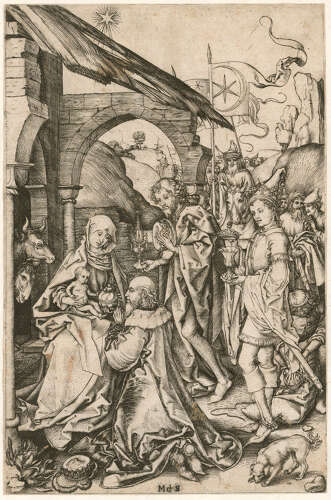
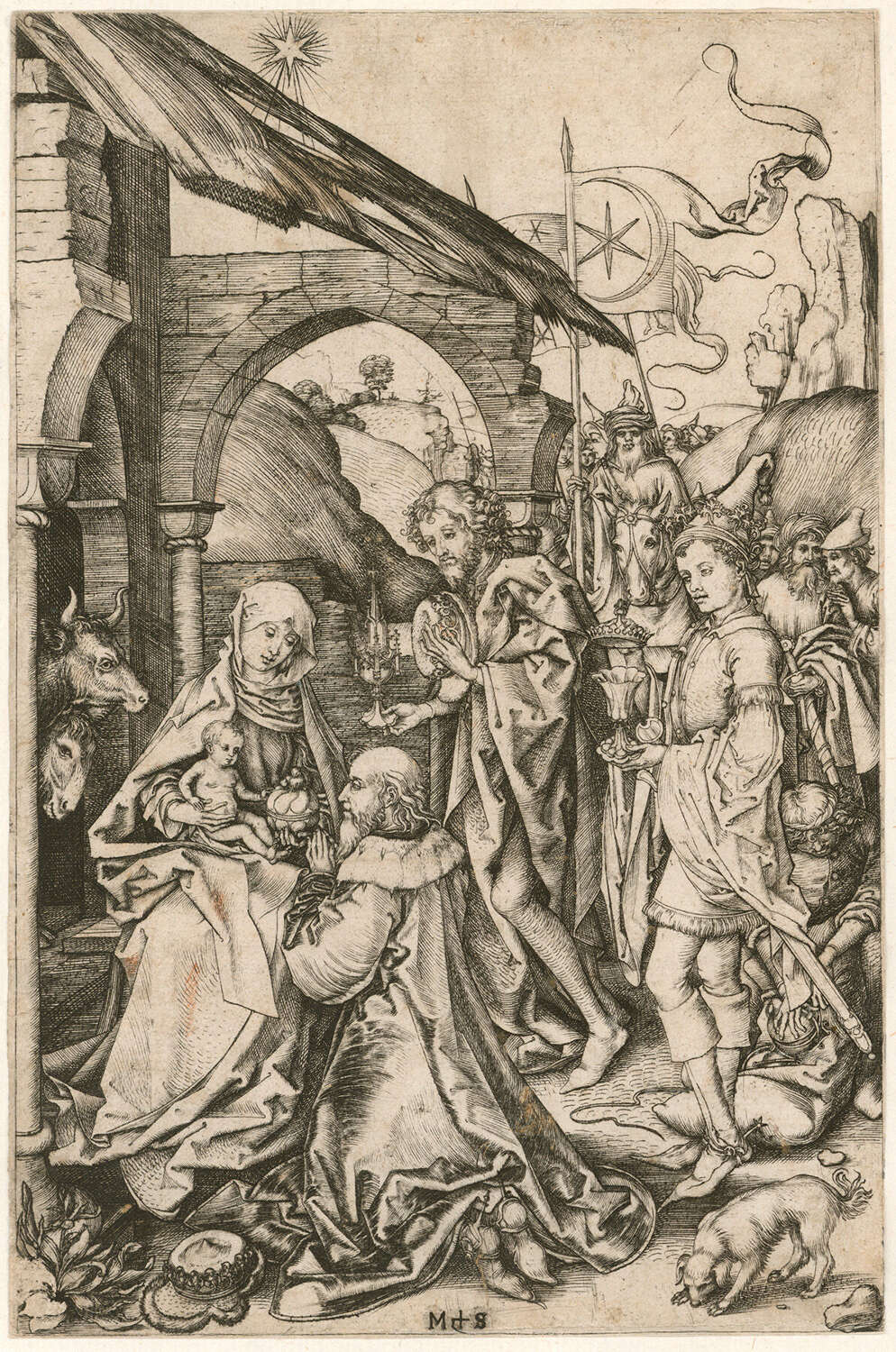
The Adoration of the Magi.
Engraving; c. 1460-70. Lehrs 6, the first of two states, before the additional rays of light from the star at the upper right were added, and before embroidered letters were added to the cloak of the figure at the extreme right, and before the apparent addition of some of the linear details of the cloak of the kneeling Magus. Hollstein 6, the first of four states. Our impression constitutes only the second known impression of the first state. The other impression is at the Metropolitan Museum of Art, New York.
In very good condition, very fine strips of blank paper added at the top and bottom of the sheet, a short carefully closed tear from the bottom to the left foot of the kneeling Magus, some slight staining in the upper roof and sky area, and a faint area of red color on the Madonna’s skirt. The upper right zone of the sheet, somewhat summarily printed in the New York impression, is in our sheet more effectively printed.
The Adoration of the Magi constitutes a central theme in the Nativity of Christ. The great and the good from distant lands follow divine guidance to worship the Christ Child. Their appearance, solemn and festive, marks the beginning of Christ’s centrality to the faithful.
Schongauer’s Adoration, one of his largest engravings, represents an exceptionally detailed version of this important subject. The Madonna forms one of the foci of the composition. She is one of the largest figures, and she is separated from the rest of the composition. Her elegant features, carefully enhanced by her wimple, dramatize her femininity. She may be compared to the Virgin and Child on a Grassy Bank, here more womanly, and thus perhaps more a queen of heaven receiving homage.
Each Magus presents a different stage of life, and thus with different faces and costumes. The young Magus at the right wears an elegant short coat and an exotic conical hat decorated with metalwork objects and a bell hanging from the top. It is typical of Schongauer’s inventive details.
The onlookers crowding close to the Madonna and the Magi, along with the animals in the manger, the dog in the foreground and the fragmentary architecture add the necessary element of simplicity. The density of the composition highlights one of Schongauer’s most daring omissions. Joseph, usually close to the Madonna and rarely omitted from the subject, even if he plays a subsidiary role, is here notable by his absence. This omission, a sovereign decision on Schongauer’s part, makes the composition more direct and emotionally charged as the Madonna whose figure matches the Magi in scale, becomes their co-equal in the narrative.
256 x 168 mm 10 1/16 x 6 5/8 inches
1. This last alteration is very small, so far as can be seen. The area of additional line work in the cloak of the kneeling Magus in the second state is visible on his sleeve where it meets the ermine cape, and some five mm below the ermine cape.
2. In the New York impression, the thatched roof is unevenly inked and the blank area around the banner with the
star and crescent is not well wiped.