Code: 10130
Dimensions:
Attributed to CHRISTOPH AMBERGER Augsburg c. 1505 – 1562
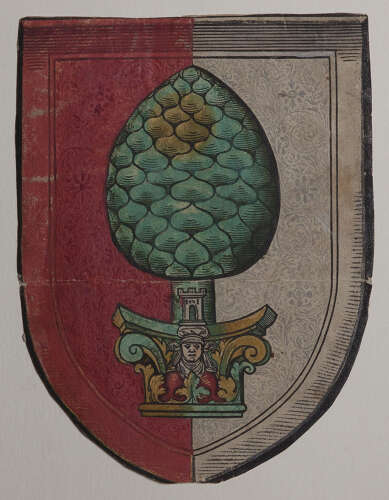
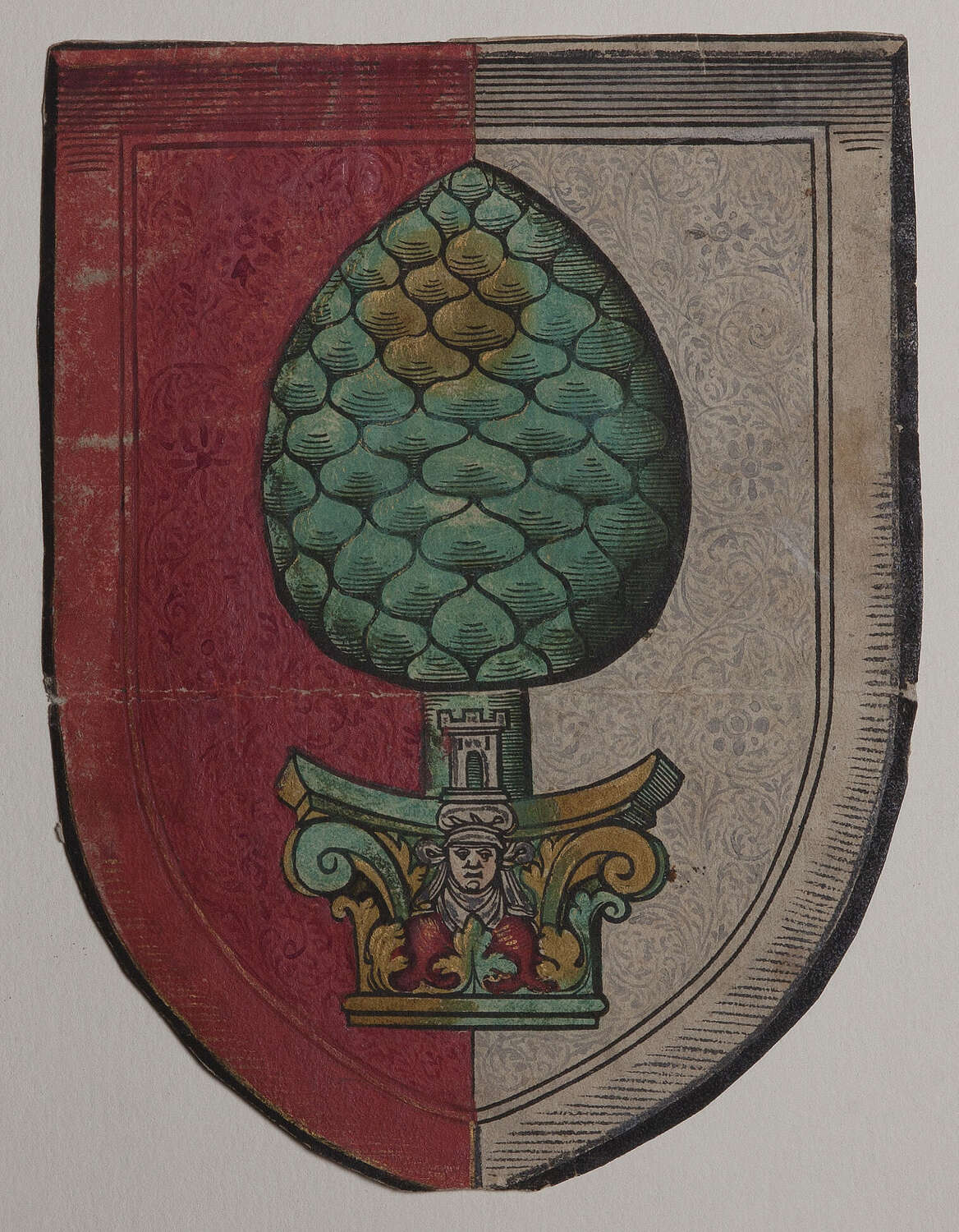
Large Coat of Arms for the City of Augsburg.
Woodcut in colors, printed with a black line block and a gray block for the background rinceaux, and with contemporary hand coloring in green, red and touches of gold; c. 1540. Haemmerle, Die Buchzeichen der freien Stadt Augsburg, Haemmerle 1. Ilse O’Dell, Deutsche und Oesterreichische Exlibris 1500-1599 im Britischen Museum, London 2003, cat. no. 15. In very good condition, an old horizontal fold partially visible recto, cut to the edge of the image and with the loss of the tip of the shield at the bottom and some slight rubbing at the left edge. Of the greatest rarity.
Ad Stijnman presumes this woodcut was used for official representations of the town. He notes that such large printed coats of arms were pasted on walls to function as mark of ownership, such as in conquered territory in war time, or to honor an inn where municipal dignateries had stayed (to their satisfaction). More examples and information can be found in Horst Appuhn, Christian von Heusinger, Riesenholzschnitte und Papiertapeten der Renaissance, Unterschneidheim: Uhl, 1976, pp. 92, 94-96, figs. 66, 67, 72.
Such a woodcut constitutes a remarkable survival and an exceptional concretization of civic pride in a most unusual format. Augsburg had become an Imperial Free City in 1276, a matter of intense local pride, and in the early Renaissance had become an artistic center, fueled in part by copper and silver mining in the Tyrol.
Amberger was only one of several prominent Augsburg artists. Hans Holbein, Hans Burgkmair and Gregor Erhardt were active from the beginning of the 16th century. Later both Hubert Gerhard and Adrian de Vries oversaw monumental public fountains, and gold and silversmiths of the highest quality were also active in Augsburg.
It is not surprising that even an object as utilitarian as our woodcut manifests the spirit of Renaissance Augsburg, which had since the later 15th century been a center of printmaking. The pineapple, long a symbol of the city, sits upon an elegant composite Corinthian capital, a bold statement of the wealth and artistic importance of the city.
203 x 157 mm 8 x 6 3/16 inches