Code: 10138
Dimensions:
PARIS c. 1503
Publishers ULRICH GERING active Paris c. 1470 - 1508, died 1510
and BERTOLD REMBOLT active Paris c. 1494 - 1508
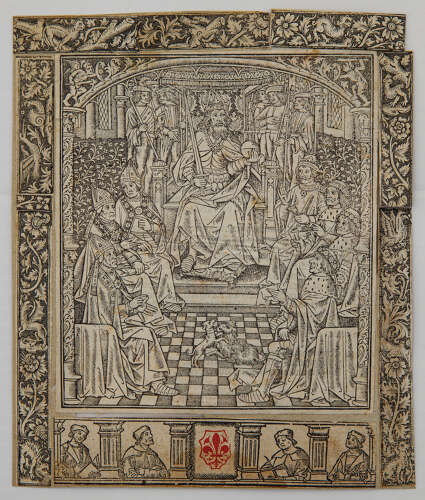
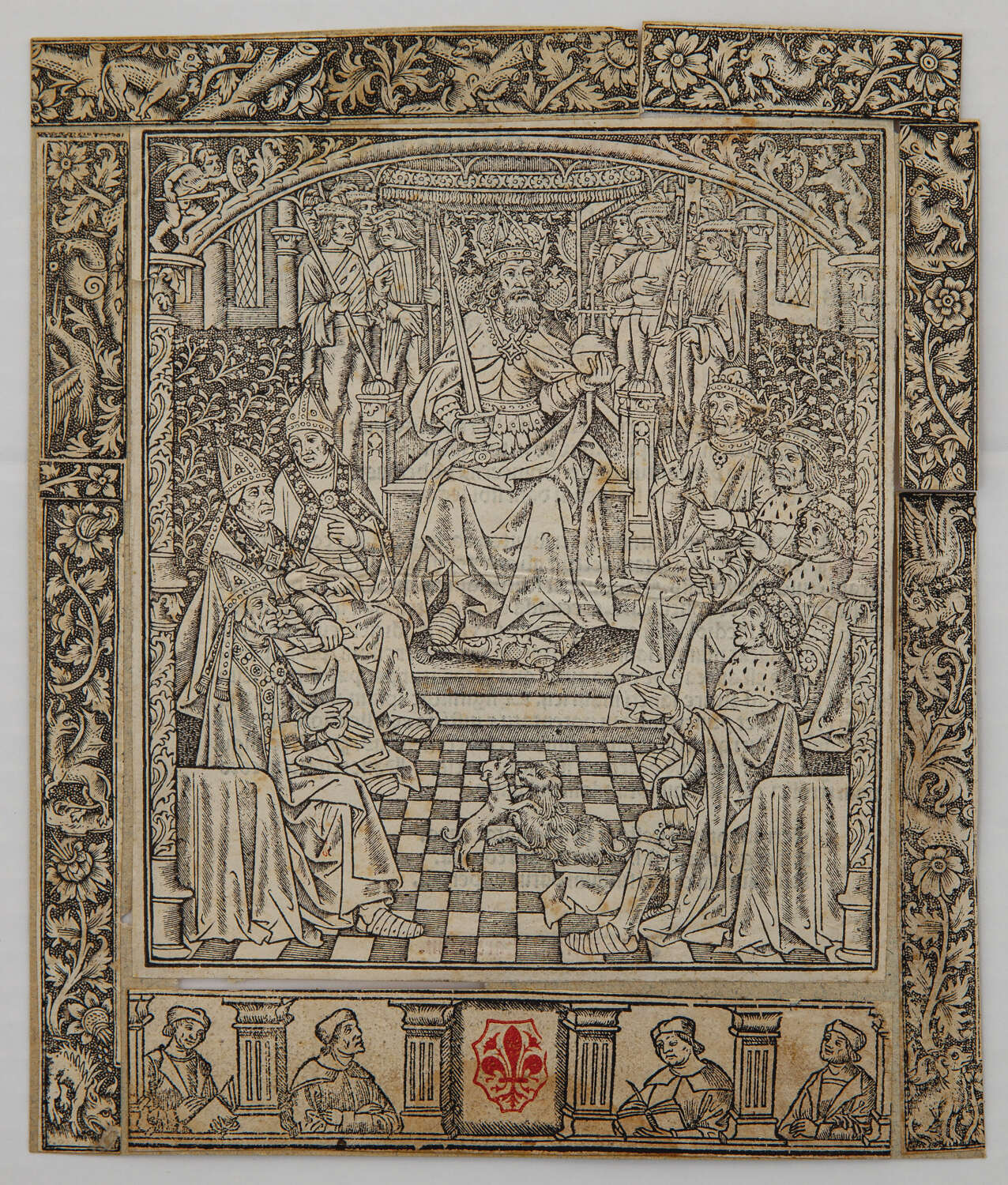
Justinian in Council.
Metalcut; c. 1503. Probably designed and executed for the 1503 edition of Justinian’s Institutiones (Novellae Constitutiones) of the Corpus Juris Civilis, Paris published by Ulrich Gering and Berthold Rembolt, and then re-used in subsequent editions in the early 16th century (1503, 1511 and others as late as 1529). Apparently, there are no copies of this book in the United States in any edition. It is not clear as to from which edition our sheet was taken, but a preliminary examination probably excludes the edition of 1529, as the copy which has been located shows some deterioration of the block which is not present here. A very fine impression in fine, fresh condition; with associated metalcut panels, presumably from the same publication, placed above and at the left and right of the image.
A former owner who came upon a defective copy must have taken the detailed metalcut borders used in the other pages of this book to frame the image of Justinian in Council. These metalcuts must have been cut and/or designed by the author of the initial on the reverse of our sheet.
The panels at the edge of the sheet represent animals and plants; many are fanciful or fantastic. All are detailed and spirited, printed recto-verso and among the most appealing of such metalcuts. Although it is unclear as to which edition our metalcuts were taken, a comparison of our impression with the delicate printing character of the impression from the 1529 edition, suggests that our impression must come from or the 1505 or 1511 editions.
The portrait of Justinian, dressed in contemporary fashion, may owe something to portraits of Emperor Maximillian I, whose long nose and penetrating eyes were easy to characterize. Also, the distinctive openwork crown with crockets which Justinian wears resembles the crown which Maximillian wore on occasion. Such resemblances would have represented a convenient form of flattery for an emperor whose political ambitions faced constant pressure from restive subjects and recalcitrant princes.
The metalcuts represent a late use of this medium for book illustration, as after 1500, metalcut was almost never used for such purposes. The medium must have been rather expensive, and thus the book must have been a deluxe production. Woodcut illustrations may have replaced metalcut on account of production costs.
We are grateful for the help of Hosea Baskin with the description of this print.
152 x 133 mm 6 x 5 ¼ inches
With added metalcut borders: 201 x 171 mm 7 15/16 x 6 ¾ inches