Code: 10114
Dimensions:
PAUL GAUGUIN Paris 1848 - 1903 Atuona, French Polynesia
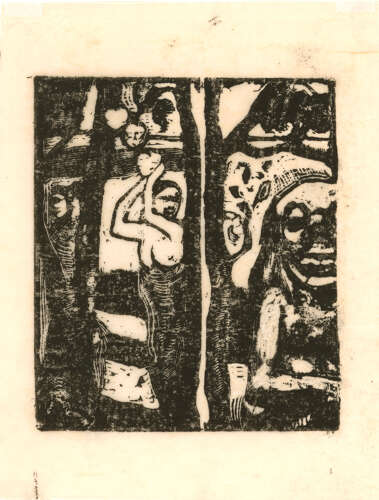
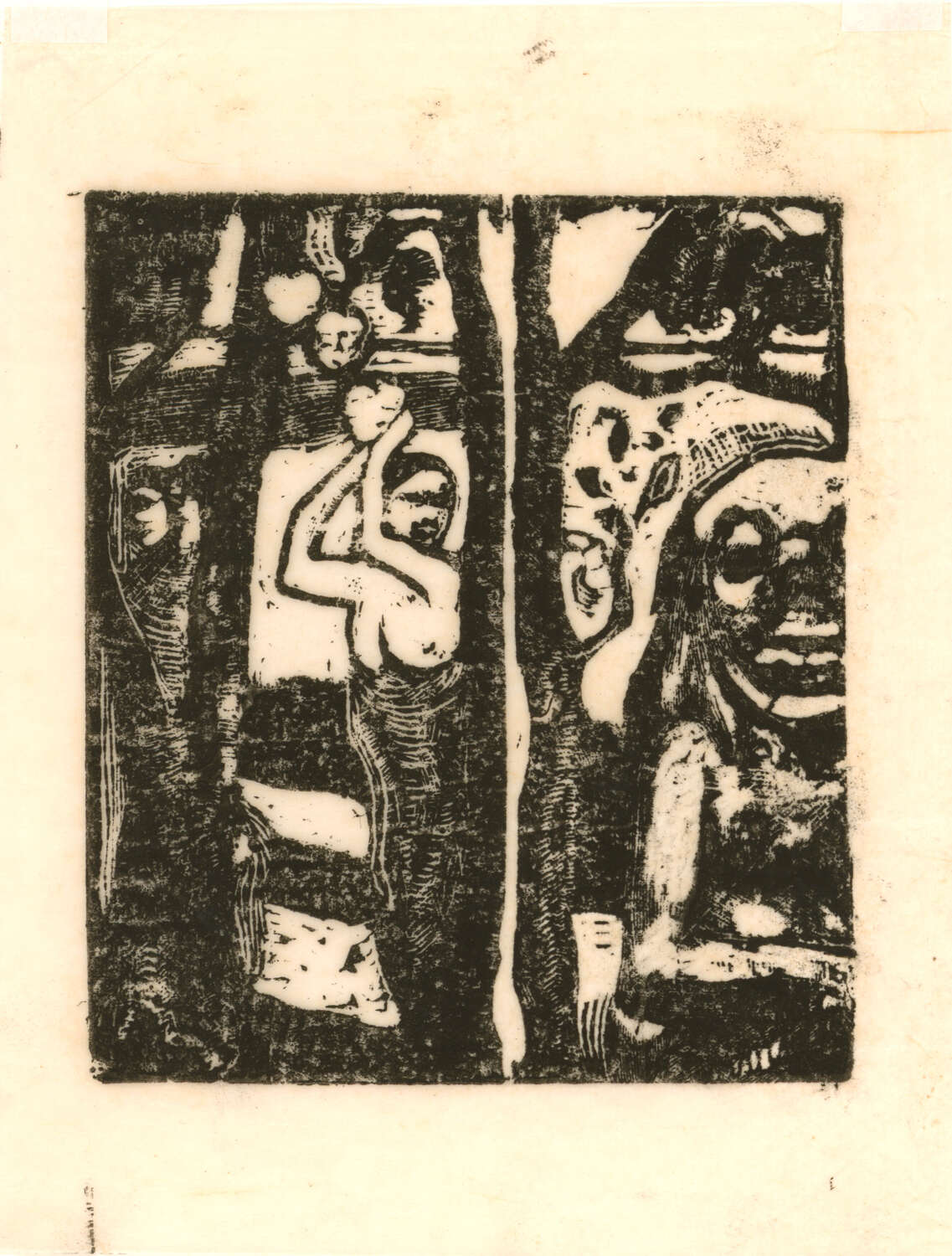
Woman Picking Fruit and the Savage (Femme cueillant des fruits et oviri).
Woodcut in black ink on thin ivory-colored Japan paper; 1894/1895. Mongan, Kornfeld & Joachim 36, only state. An extremely fine, uniform impression, with exceptionally fresh surfaces and with large margins; almost never so fine. The Japan paper, tissue thin and very translucent, is extremely delicate. Other impressions to which we have been able to compare to ours, show damages to the paper and stains.
Gauguin almost surely did not have access to a printing press in Tahiti, printing under conditions quite different and more haphazard from those in a Paris studio. Impressions, therefore, vary considerably in clarity and force; so far as we have been able to compare, our impression compares favorably to those in public instituions or private collections.
Gauguin’s work in Tahiti has become the stuff of legend. His passion for the people and the landscape of this island paradise produced one of the most remarkable oeuvres in the history of modern art. Behind this romantic view of a European artist’s passion for a world in which the culture of an indigenous people was still preserved from the depredations of European colonists and overseers, lies Gauguin’s remarkable achievement; paintings, sculpture and graphic works whose designs were imbued with a passionate acceptance of the world of Tahiti.
Oviri in Tahitian means ‘wild or savage’ or ‘one who sleeps in the wilderness’, but the figure itself comes from Gauguin’s imagination. The looming face of Oviri, at the lower right of our woodcut, constitutes a very considerable re-thinking of another woodcut that Gauguin (Mongan, Kornfeld, & Joachim 35) executed in Pont-Aven or Paris in 1894, in which Oviri is presented as a nude woman with a palm tree to her right.
Gauguin in 1896 or 1897, then in Tahiti, added to the left half of the block he had begun in 1894, a semi-nude woman standing near a large tree who reaches up to pick fruit. To that tree stands to another tree to the right whose luxuriant branches frame the figure of Oviri, now occupying only the lower right of the woodcut. The design of the woodcut is, of course, no accident. Gauguin, so deeply attached to the world of the indigenous people of Tahiti, may well have seen his woodcut as the vision of Tahitians as inhabitants of a world idyllic and unspoiled, but mysterious and uncontrollable. The landscape holds fruit and in it also lives Oviri.
105 x 90 mm 4 1/8 x 3 9/16 inches