Code: 10135
Dimensions:
JACQUES ANTOINE MARIE LEMOINE Rouen 1751 - 1824 Paris
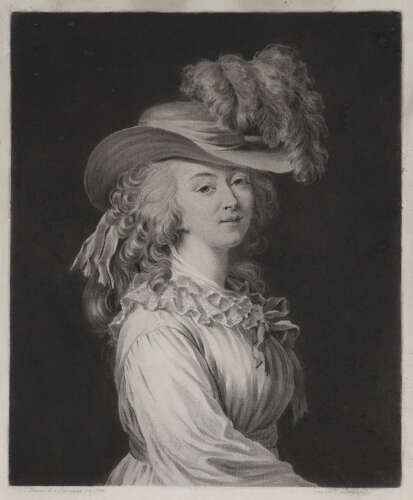
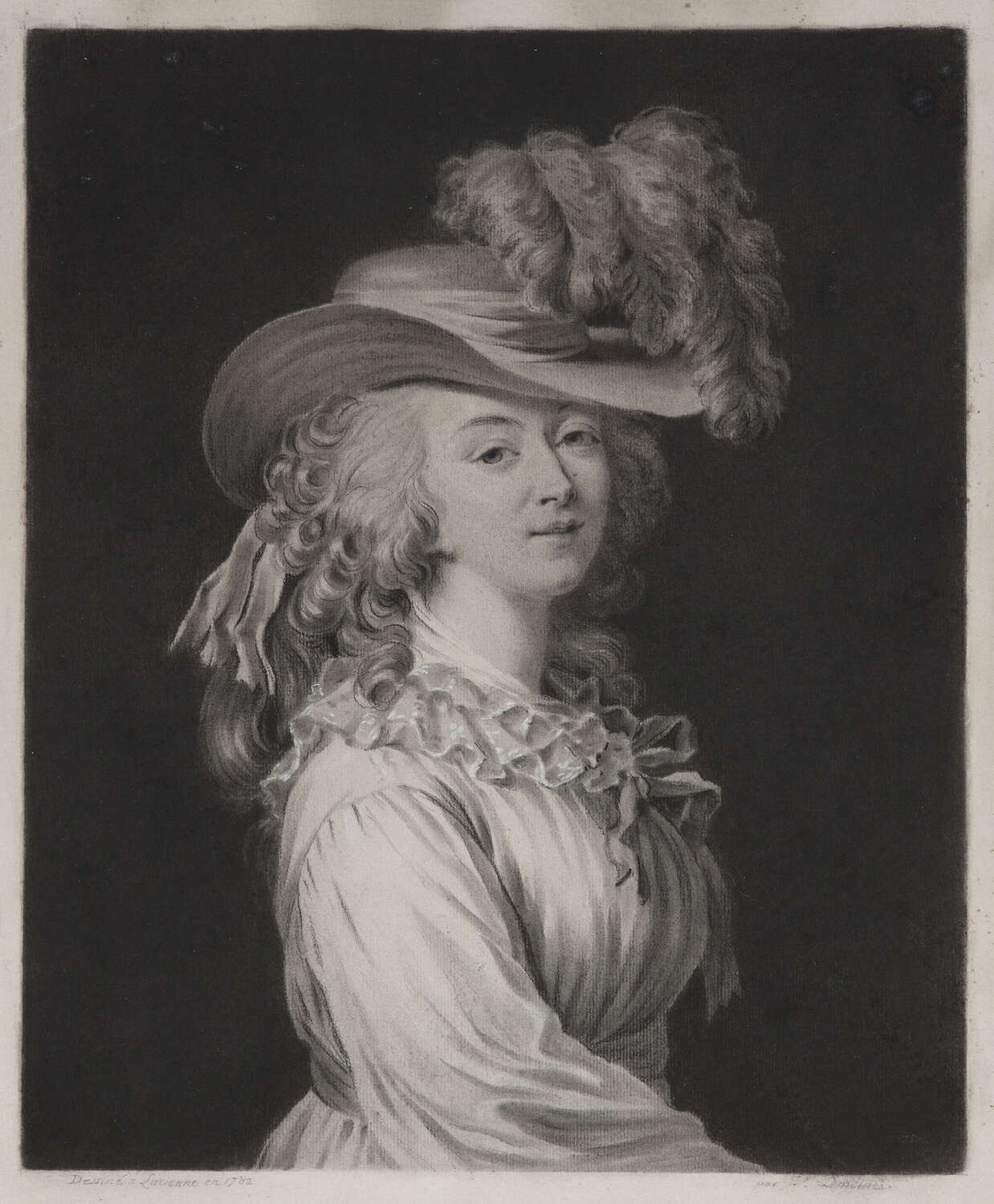
Portrait of Madame Du Barry.
Drawing in black chalk heightened with white. Signed and dated 1782 by the artist. “Dessiné à Lucienne en 1782. J.A. Lemoine.”
Literature: E. & J. Goncourt, Portraits Intimes du XVIIIe Siècle, Paris, 1857-58, pp. 1-9.
Our drawing, a version of Elizabeth Vigée-Le Brun’s portrait, was commissioned by Madame Du Barry’s lover, Lord Henry Seymour in 1782; Seymour also commissioned a companion portrait of himself, present whereabouts unknown. Lemoine was a gifted portraitist; he worked frequently in a black and white palette.
This palette called in France manière noire referred to the use of black chalk with white heightening in frank imitation of mezzotint, the graphic technique in which the engraver first covered the engraving plate with a dense series of indentations that would then print solid black and then used a scraper to burnish out the areas for lighter highlights. Drawings in the manière noire became extremely fashionable in the last quarter of the 18th century in France.
Madame Du Barry, née Jeanne Bécu (1743-1793) was arguably the most famous courtesan in France in the 18th century. Employed by a casino owner, Jean-Baptiste Du Barry in 1763, when she was twenty old, she became first linked to the Maréchal de Richelieu and in 1768 became Maitresse-en-Tître to King Louis XV. By 1769 she was presented at court and shortly after became Maitresse Declarée. By this time her triumph over her principal rival, the Duchesse de Gramont, was complete. Her costumes and her jewels – a spectacular diamond necklace costing a reputed two million livres – provided by the crown were dazzling. Louis gifted her with the Château de Louveciennes in 1769.
Louis XV died in 1774; at the instigation of Marie Antoinette, whose dislike for Du Barry was well known, the young King Louis XVI exiled Du Barry to the Abbey of Pont-aux-Dames, near Meaux-en-Brie. Although at first the nuns were suspicious of their famous guest, her demeanor soon won them over. In 1775, she was finally able to return to the Château de Louveciennes. Now, at the age of thirty-one, she became the lover of the Duc de Brissac.
Lord Henry Seymour, a widower by 1773, then entered the life of Madame Du Barry. Seymour left England and had married Thérèse De Panthou in 1775. In 1778, he moved to Prunay near Versailles, near Du Barry’s Château at Louveciennes, and almost surely then become Madame Du Barry’s lover. The pair of portraits by Lemoine were drawn in 1782, commissioned by Lord Seymour. In 1793, during the reign of terror in revolutionary France, Madame Du Barry was arrested for treason and beheaded.
Sight: 330 x 270 mm 13 x 10 5/8 inches
Note: The Vigée-Le Brun portrait is known in three versions; one in the Rothschild collection, another at the National Gallery of Art, Washington, and the third at the Philadelphia Museum of Art.