Code: 10145
Dimensions:
LOUIS LAFITTE Paris 1770 – 1828 Paris
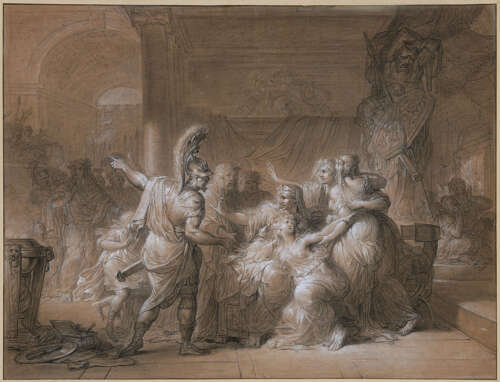
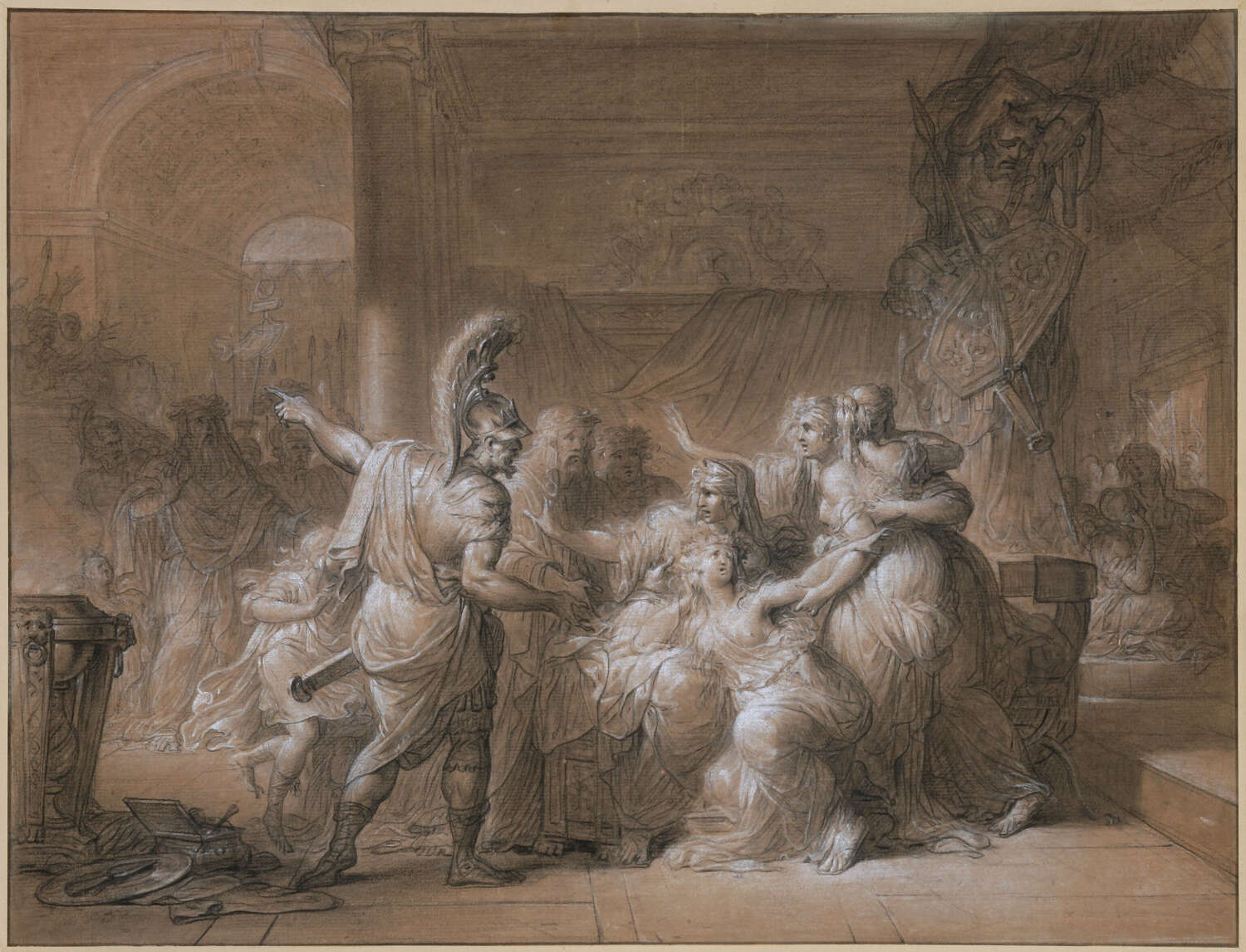
The Priests arriving to take Iphigenia to the Sacrifice.
Black chalk with white heightening on rose-brown tinted paper. Exhibited at the Salon of 1791.
Lafitte was a student of Gilles Demarteau and Jean-Baptiste Regnault. His talents were recognized at the young age of 18 when he won a prize medal, and again a Prix de Rome in 1791 with his painting, Regulus Returning to Carthage, now in the Ecole des Beaux-Arts, Paris; in 1793 he was made a member of the Academy in Florence. From 1791 to 1817, he spent most of his time in Paris, making drawings for prints and book illustrations, as well as paintings.
In 1799 he made allegorical paintings for the dining room at Malmaison, as well as wallpaper designs of the Story of Cupid and Psyche for Dufour’s wallpaper printing establishment, an example of which is at Malmaison. During the Restoration, Lafitte made designs for the Sèvres Porcelain Factory and for Charles Cahier, then one of the leading Parisian goldsmiths.
Our sheet, more highly finished than most of his drawings, was exhibited in the Salon of 1791 along with three others, as Quatre Dessins, sujet d’Histoire. One of these, Achille Pleurant sur le Corps de Patroclée, is now at the Musée Tavet, Pontoise. Lafitte’s style is closely tied to French Neo-Classicism; in our drawing the emotional tension of the scene is brought to a very high pitch. The story, from the history of the Trojan War, details the moments before the sacrifice of Iphigenia. Iphigenia, the daughter of Agamemnon, the leader of the Greeks, was to be sacrificed to appease the wrath of Diana and allow the wind bound Greek ships to leave for Troy. Diana, relenting at the last moment, snatched Iphigenia away and made her one of her priestesses; for the late 18th century, the story was one of many from classical myth or history that was used as an exemplar of honorable action even in the face of personal loss.
Lafitte has chosen the moment just before the priests come to take the terrified young girl away. As the priests stride forward, her father Agamemnon stands with his back to the viewer, pointing toward the priests, as his frightened daughter futilely gestures in helpless terror to her handmaids. Lafitte focuses more on the terror of the young woman and the pathos of the scene than on Agamemnon’s painful choice. This moment in the story of the Trojan War is one of the most frequently retold in classical literature. Both Aeschylus and Sophocles wrote plays on the subject (no longer extant), as did Euripides and in the modern era, Racine and Goethe. Lafitte’s masterful use of white heightening intensifies the drama of the moment.
381 x 501 mm. 15 1/16 x 19 ¾ inches