Code: 10125
Dimensions:
PAULINE AUZOU Paris 1775 - 1835 Paris
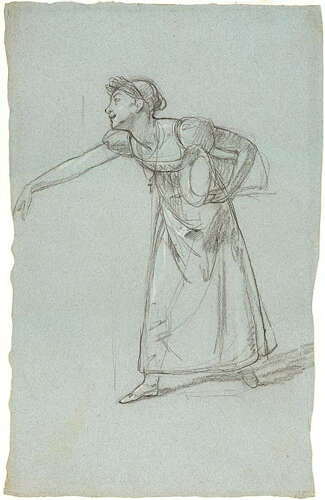
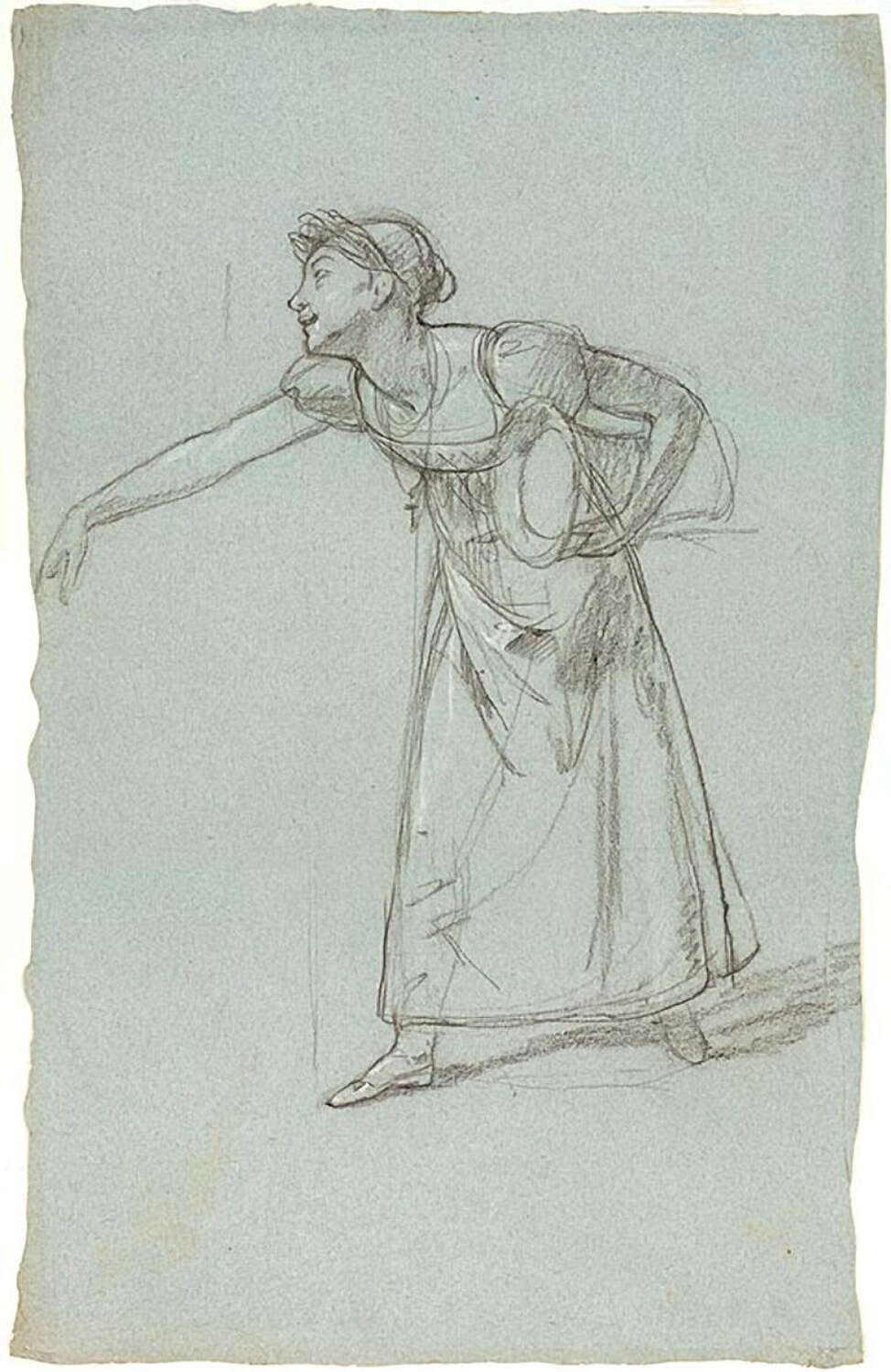
Young Girl holding a Vase.
Black chalk heightened with white on blue paper. In fine, fresh condition, the blue paper, bright and unfaded. A preparatory drawing for the young girl at the lower right in the painting The Arrival of the Empress Marie-Louise at Compiègne, 1810 - the painting was exhibited at the Salon in the same year and is now at Versailles (Musée National du Château de Versailles).
She was born Jeanne-Marie Catherine Desmarquet, and took the name La Chapelle when she was adopted by a cousin. When she married Charles-Marie Auzou in 1793, she took his name.
After a short period in the studio of Jacques-Louis David, Auzou exhibited two works in the Salon of 1793 when she was only 18. In 1802 she began work in the studio of Jean-Baptiste Regnault, as one of several young women to study with Regnault, a relatively unusual situation for women who aspired to work in a male-dominated profession. By 1810 she had found favor with the imperial court. Her painting of The Arrival of the Empress Marie-Louise at Compiègne is typical. The Empress and Napoleon receive bouquets of flowers from a group of young women. The figure of the young girl in the right foreground, for which our drawing is preparatory, adds an element of informal charm to the painting.
Her oeuvre consisted of portraits as well as genre scenes. She took inspiration from history and mythology. Her best efforts are indebted to the Dutch painters of the 17th century, in particular Pieter de Hooch and Gerrit Dou. Auzou was one of the principal exponents of the anecdotal genre which at the time was seen as a particularly French subject matter.
It may well be that her position in the competitive world of Parisian art suffered at the end of the Napoleonic period, as after 1817 her participation in the Salon came to an end. Perhaps then, as Auzou must have keenly felt the difficult postion of women in the fine arts, she opened a studio for women only which she maintained until shortly before her death in 1835.
458 x 285 mm 18 1/16 x 11 1/4 inches