Code: 10118
Dimensions:
WALLERANT VAILLANT Lille 1623 – 1677 Amsterdam
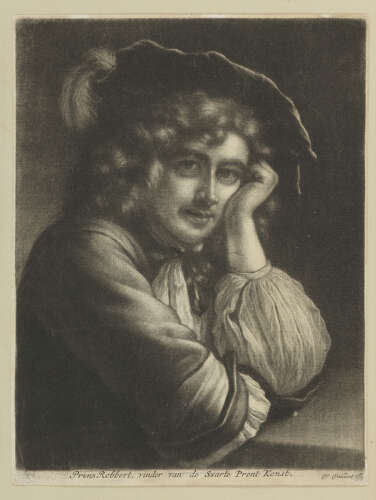
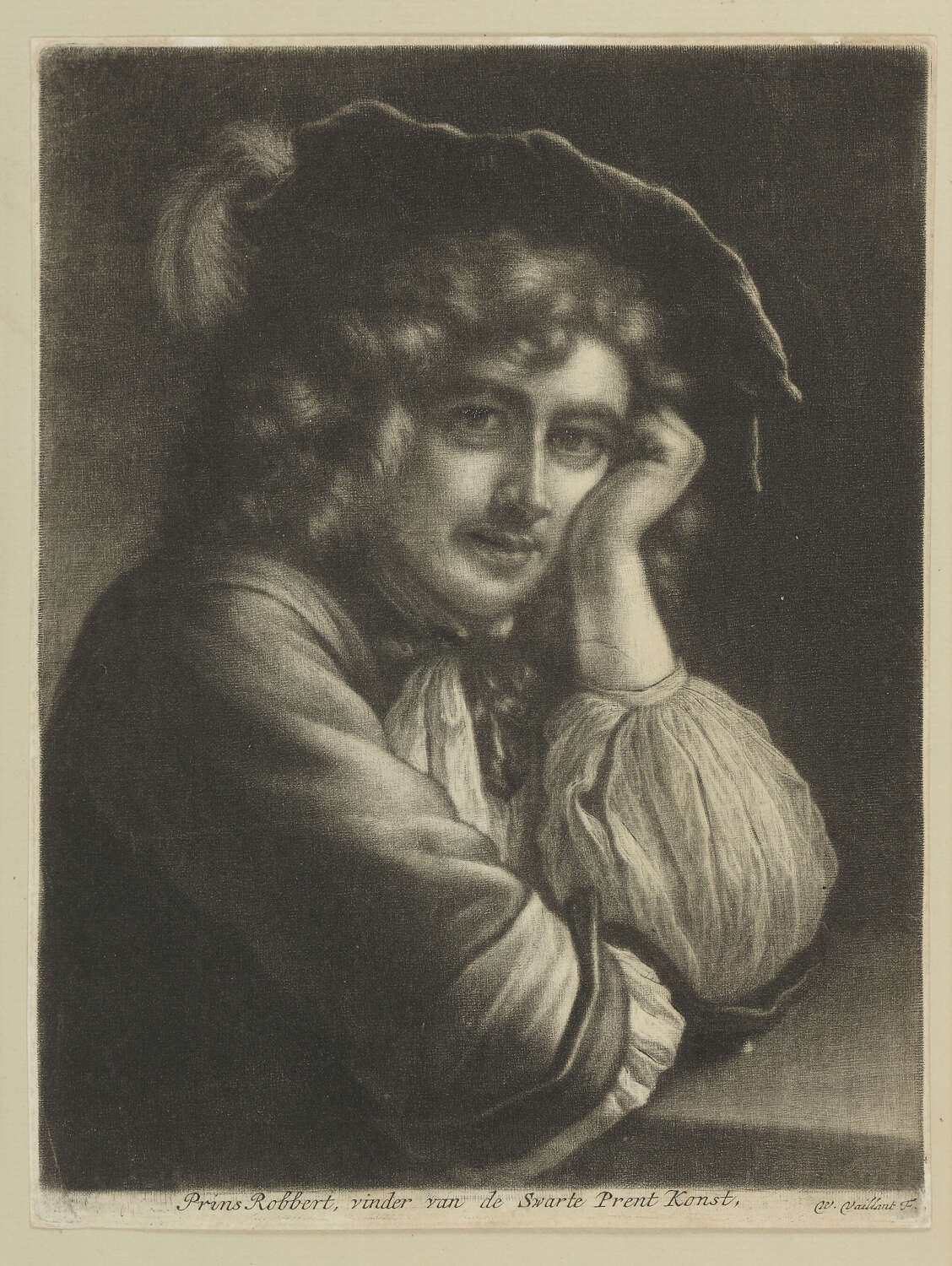
The so-called Portrait of Prince Rupert.
Mezzotint, in reverse of the mezzotint attributed to Prince Rupert. Wessely 55, Hollstein 192, the second of two states, with the engraved inscription Prins Robbert, vinder van de Swarte Prent Konst. A free copy in reverse of a mezzotint attributed to Prince Rupert, Hollstein, Ruprecht rejected [36] mentioned and rejected by A.M. Hind, Studies in English Engraving, IV, Prince Rupert and the Beginnings of Mezzotint, The Connoisseur, XCII, Dec. 1933 pp. 382-91. A brilliant impression in excellent fresh condition. Hinged to an old album sheet, with thread margins all around, a tiny crease at the lower left corner.
Vaillant was a contemporary of Prince Rupert (1619-1682), the Royalist soldier in the English Civil War and talented printmaker, and possibly the inventor of the mezzotint. Vaillant’s output was large and varied, and among his prints were a number of portraits. Dutch portraiture in the later 17th century constituted a most flexible medium, in some cases embodying the full panoply of court or aristocratic portrait topoi, emphasizing the personal grandeur and social standing of the sitter, or a more existentially direct depiction of thoughtfulness, connection to the audience or personal character.
Vaillant practiced in both modalities, and our mezzotint stands much closer to the second approach. The gesture of thoughtfulness, head resting on and bent arm and gazing directly at the viewer constitutes a presentation of the artist as thinker and seer. The so-called Prince Rupert original, while traditionally described as the model for Vaillant’s version, is clearly inferior to it in several respects. The so-called Rupert version lacks the focused eyes with which Vaillant enlivened the face of his sitter, as in this version the sitter more directly engages us with his glance. Rupert’s sitter’s arm with its spindly proportions does not enhance the physical presence of his gesture, thus weakening the sitter’s thoughtful gesture.
Sheet: 216 x 165 mm 8 ½ x 6 ½ inches
1. The relationship between the two prints is perhaps not a clear as has been believed. The assumption that the London Rupert (1838,0420.17) is the original from which Vaillant worked is open to question. The London mezzotint is identified as representing Prince Rupert, but is at least possible that it is a copy after Vaillant’s mezzotint. The identification of the London print is based on the relationship to the Vaillant version with its identifying inscription. The attribution to Prince Rupert, made probably first by Wessely in 1865 in Wallerant Vaillant Verzeichniss seiner Kupferstiche und Schabkunstblatter, was first published in 1865, well after the acquisition of the so-called Rupert at the British Museum in 1838. Wessely apparently took the attribution from British Museum notes; Hind in his article in 1933 was the first to reject the attribution to Rupert. His opinion is now generally accepted. It does not appear that he ever considered the idea that the rejected print was a copy after Vaillant.
2. It is also interesting that Vaillant only added the mention of Rupert in the second state of his mezzotint. This inscription would certainly have enhanced the salability of the print. He may have used Rupert’s ‘Great Lansquenet’ or Standard-Bearer, (Hollstein 16) or the‘Little Lansquenet’ or Standard Bearer (Hollstein 17) as general models.