Code: 10108
Dimensions:
PETER BEHRENS Hamburg 1868 – 1940 Berlin
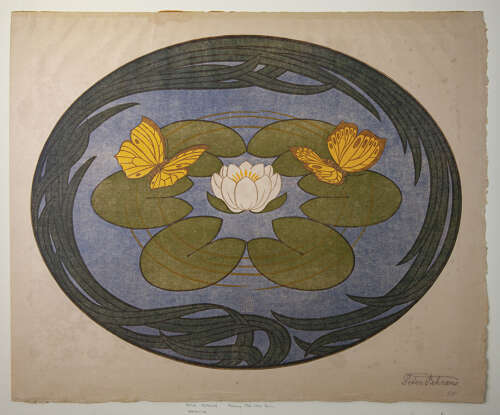
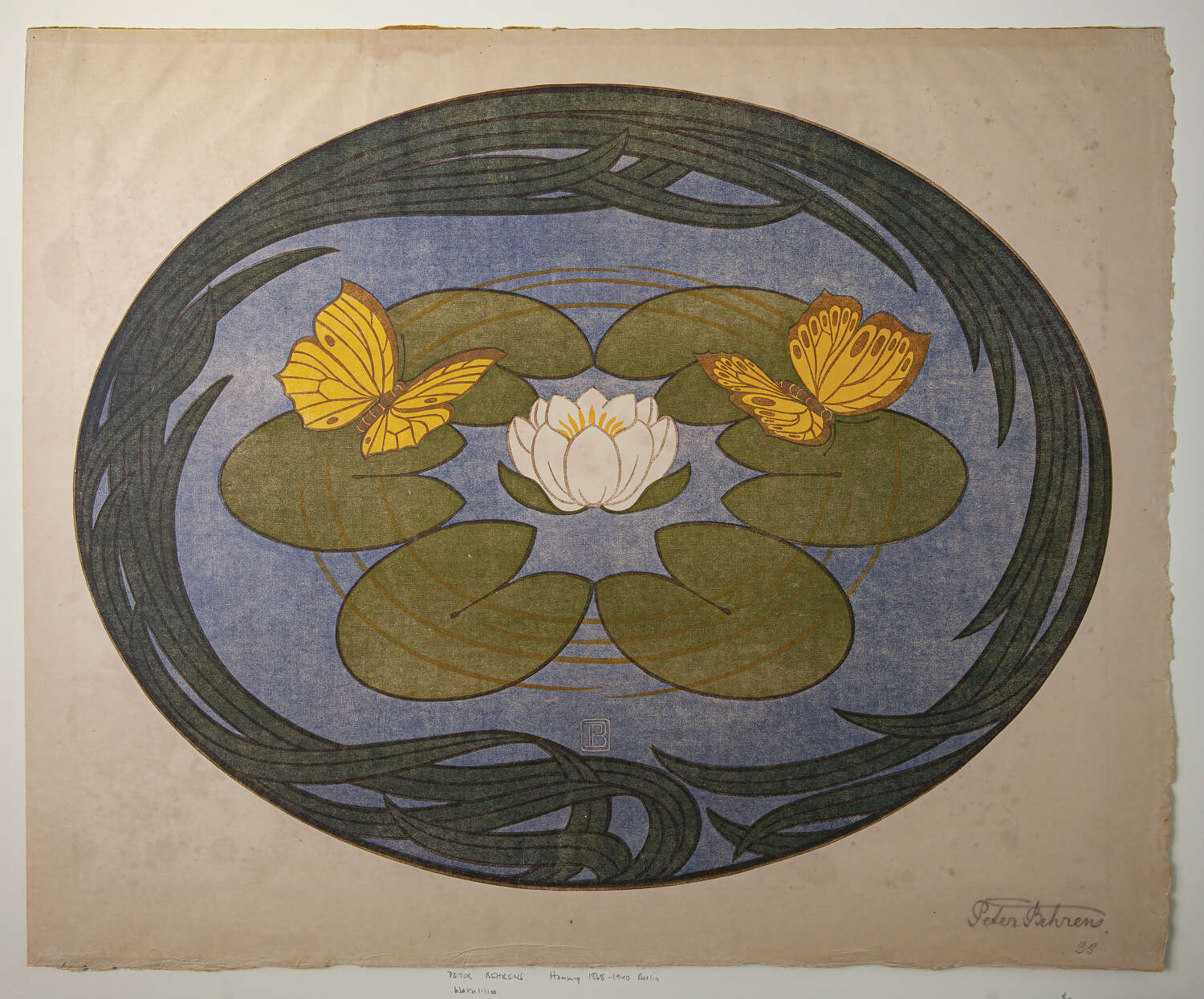
Water Lilies.
Woodcut in colors; circa 1900. With the artist’s monogram at the center of the image. On thin Japan paper with apparently full margins. Signed by the artist lower right lower right in the margins around the oval image. A very fine impression in excellent condition, the colors particularly fresh; apparently of the greatest rarity.
Behrens worked as a graphic designer, painter and architect. In his early years he was one of the most important exponents of Jugendstil, the Art Nouveau style practiced in Germany and Austria. By 1890 Behrens had moved to Munich and was one of the founding members of the Munich Secession, and soon after, the Freie Vereinigung Münchener Künstler. His work with the magazine Pan, one of the leading art and literary publications in Germany at the end of the 19th century, produced his famous Der Kuss [The Kiss], a woodcut in colors published in the magazine in 1899. The Kiss was enormously popular and has become an iconic graphic image of Art Nouveau design and printmaking. Our Water lilies, much less well known, and much rarer as it was not published in an edition of any size, must date from the same period.
Water lilies represents an exact formal and iconographic analog to The Kiss. The flowing hair of the lovers surrounding their intertwined faces in The Kiss and the movement of plants and butterflies in Water Lilies show Behrens’ taste for abstract movement of forms.
Behrens abandoned Art Nouveau in the first decade of the new century and developed a formal vocabulary based on geometric forms. He used this new style in projects ranging from catalogue design to furniture and architecture. In 1907 Behrens was engaged by the German electrical giant AEG [Allgemeiner Electrizitäts Gesellschaft] and as artistic adviser oversaw all aspects of design for AEG buildings and products. Behrens’ modernism was not doctrinaire; he incorporated German Neo-classical forms into his architectural designs, and after World War I even moved toward Expressionism. As a teacher he influenced Ludwig Mies van der Rohe and Walter Gropius, two of the foremost international architects of the first half of the 20th century.
496 x 634 mm 19 9/16 x 25 inches