Code: 10165
Dimensions:
After ABRAHAM BLOEMAERT Gorinchem 1564 – 1651 Utrecht
ANDRIES JACOBSZ. STOCK Antwerp c. 1580 – c. 1648 The Hague
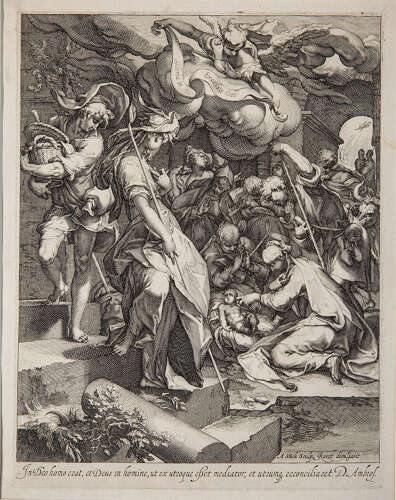
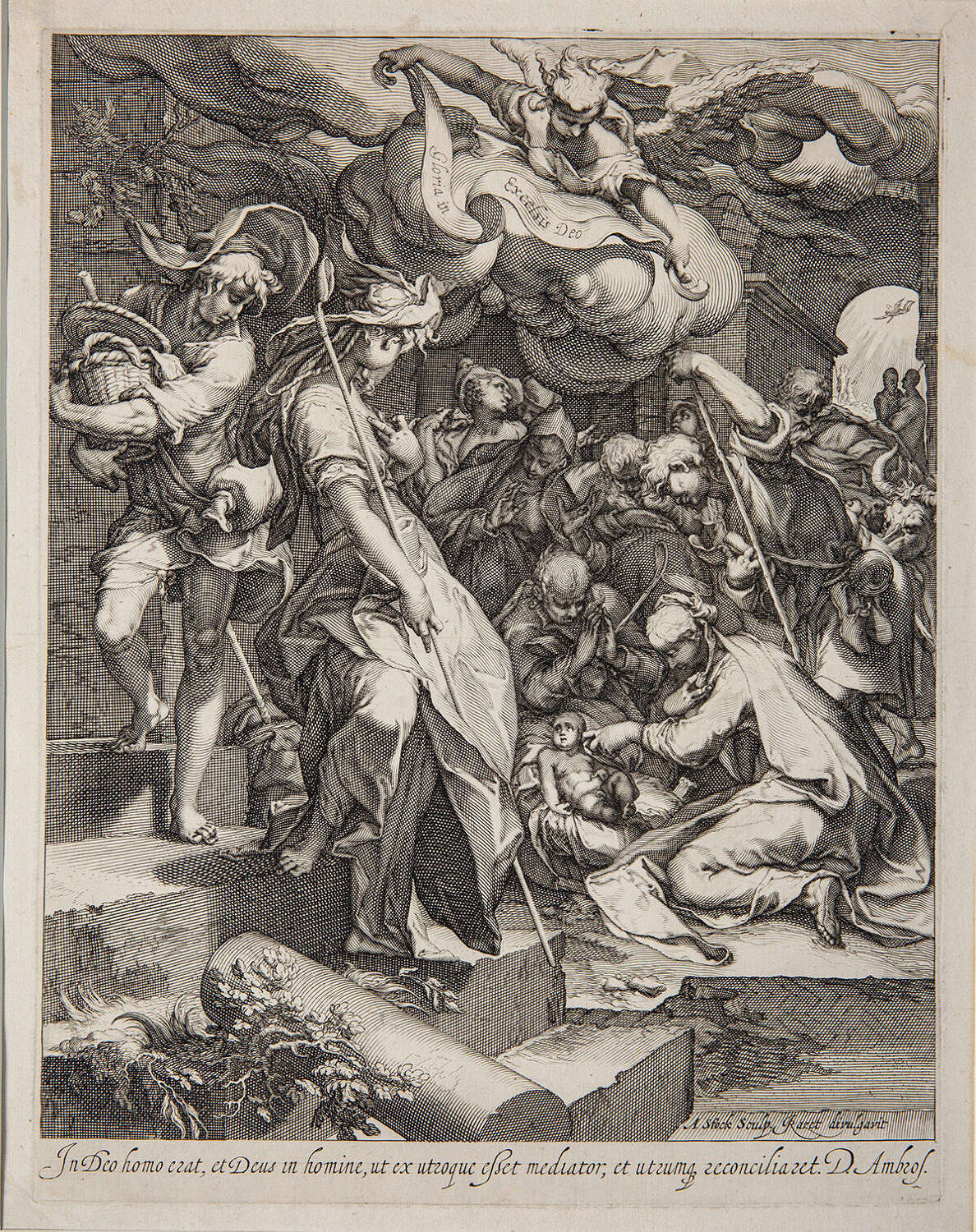
The Adoration of the Shepherds.
Engraving, after Abraham Bloemaert by Andries Stock; c.1593 or after. Hollstein 3: the first of three states. Roethlisberger 49, figure 89. Provenance: Cabinet Brentano-Birckenstock, Vienna & Frankfurt, Lugt 345. An extremely fine impression, the guidelines for the text still visible. Watermark: Crozier, similar to Heawood 1183 to 1188 (datable 1607-1616). With large margins.
While this elegant engraving has always been admired, the circumstances of its creation have not been satisfactorily explained. Hollstein was quite terse in his description, noting only that Bloemaert was the author of the model. Roethlisberger, who dismissed Stock as an ‘unimportant’ engraver, wanted to date the engraving to 1600-1605, perhaps on the basis of Stock’s traditional birth and death dates of c.1580–c. 1648. No solid information as to Stock’s dates is known.
Another engraving by Jacques De Gheyn II suggests a tantalizing and indeed convincing explanation of the genesis and dating of Stock’s engraving. De Gheyn’s Annunciation, again after Bloemaert, is dated 1593 in the first state (New Hollstein 30). The composition is entirely analogous to Stock’s Adoration, and the inscription at the front of the parapet where the Virgin Annunciate sits is engraved in an elegant cursive script identical to the inscription in Stock’s engraving. The size of the two engravings is also nearly the same.
It is not too much to suggest that the two were meant as pendants. We may add to this argument the fact that De Gheyn’s engraving was in the first state published by Razet and dated 1593, and then changed to 1599 when the plate was published by Robert de Baudous. Similarly, Stock’s engraving was first published by Razet and then in the second state by Baudous (and in the third state by Janson). This parallel printing history strongly suggests that Stock’s engraving was also published in 1593 or very shortly after that and clearly with a relationship to the De Gheyn work as a raison d’être.
Only if we remain committed to Stock’s birth date as c. 1580 would the connection to De Gheyn of this accomplished engraving seem unlikely. Stock is thought to have spent a period in the studio of De Gheyn, and if this is indeed the case the resemblance of the two works is not at all surprising.359 x 285 mm 14 1/8 x 11 ¼ inches