Code: 10144
Dimensions:
JUSTUS DE GELDER Dordrecht 1650 – after 1707
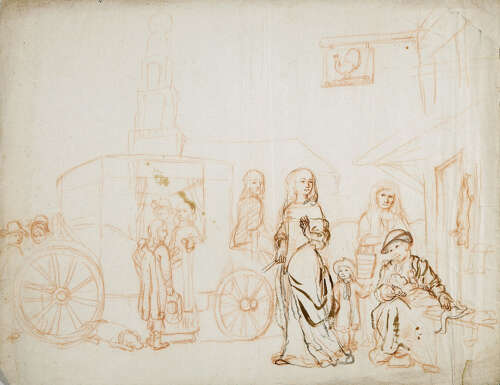
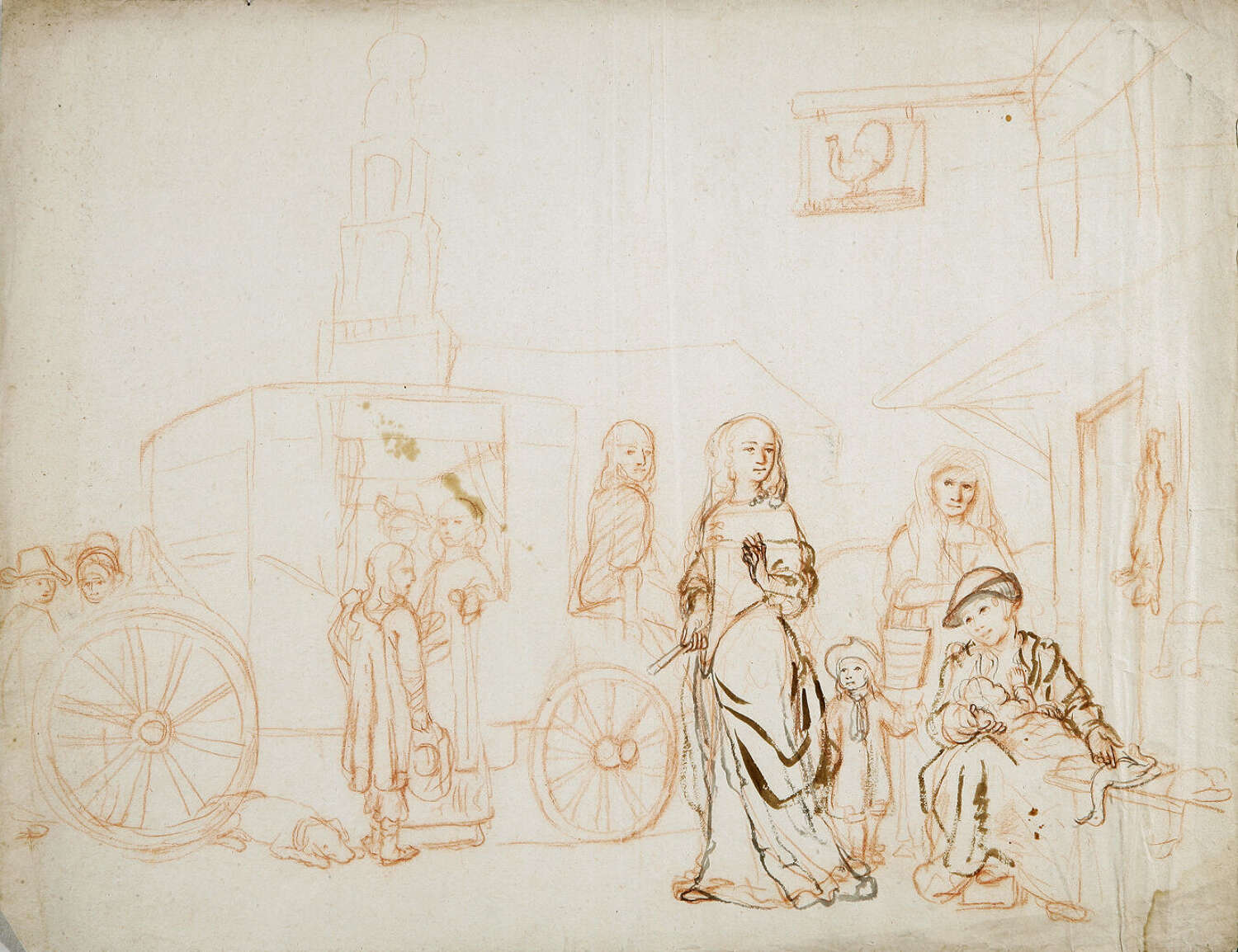
Lady with a Carriage in front of a Poultry Shop.
Red chalk, brush and brown ink.
Entry by Peter Schatborn:
“There is a group of drawings of biblical scenes and a few genre scenes that were attributed to various artists. Because the majority of authors considered the likely maker to have been Rembrandt’s pupil Jan Victors (c. 1619/20 - after 1676) on the basis of the subjects, Sumowski catalogued the drawings as “Pseudo Victors Group” under Nicolaes Maes. One of the drawings, The hurdy-gurdy player, is a preliminary study for a painting in Dordrecht of largely the same scene, regarded as Maes.
Sumowski established several connections between drawings in the group and his authentic drawings by Maes, and observed that drawings by Maes and in the ‘Pseudo Victors group’ were classified together in the eighteenth-century album of the Dordrecht artist Matthijs Balen (Dordrecht 1684-1766), which was acquired by the Rijksprentenkabinet in Amsterdam in 1957.
Robinson and Krempel no longer consider the painting in Dordrecht to be by Maes and so the attribution of the entire group of drawings came up for discussion again. Little if anything is known about Maes’s pupils who are mentioned by Houbraken, but the works of Cornelis Bisschop, Reinier Covijn and Abraham van Dijck do reveal that they were influenced by him after Maes’s apprenticeship to Rembrandt in Amsterdam and his return to Dordrecht in 1653.
The discovery of a signed painting by Justus de Gelder, Children playing on a bridge, which is dated 1671, is an important point of reference for attribution. Justus was born in 1650. He was Maes’s wife’s son from her first marriage, and the style and character of his painting tell us that he must have trained under his stepfather. Krempel associates some other paintings previously attributed to Maes with this work and suggests that if the painting of The hurdy-gurdy player is also by Justus de Gelder—which is highly likely—the drawn preliminary study in the British Museum, like the rest of the drawings catalogued by Sumowski as ‘Pseudo Victors group’, may well be by him too. The same applies to five drawings in the Lugt collection (cats. 00-00).
To a significant extent, Sumowski’s arguments in favour of the attribution to Maes also hold good for an attribution to a pupil, who took work by Maes as an example and whose drawings were kept together with those by his master in Matthijs Balen’s album. The drawing in the Lugt collection is the only one of the group to come from the Dalhousie collection, which consisted almost entirely of drawings by Maes and other artists in Rembrandt’s circle.
The red chalk drawing of A lady with a carriage in front of a poultry shop was partially worked up in brush in the same style as the group mentioned above. The composition of this drawing is akin to a painting of 1659, Outside a poultry shop, which Robinson considers to be by a follower; Sumowski regards it as by Maes, while Krempel thinks it is possibly by Maes. A group of Bible scenes in red chalk, which was acquired by the Teylers Museum in Haarlem from a Dordrecht estate in 1994, is similar to these drawings. Some were catalogued by Michiel Plomp as attributed to Nicolaes Maes and others as attributed to Samuel van Hoogstraten. Since Maes’s influence is obvious in many of these works, it is perhaps more likely that all these drawings were done by his stepson Justus de Gelder.”
Peter Schatborn
315 x 410 mm 12 3/8 x 16 1/8 inches
1.Sumowski, 8 (1984), pp. 4259-4261.
2.London, British Museum; Sumowski, 8 (1984), n° 1768, repr.; Royalton-Kisch, 2008, Maes, n° 10 (perhaps Justus de Gelder).
3.Dordrechts Museum; Sumowski, III (1983), n° 1360, repr. The painting was previously said to have borne Maes’s monogram.
4.See also Robinson, 1996, p. 142.
5.Robinson, 1996, p. 140-141; Krempel, 2000, n° E 3, possibly Justus de Gelder.
6. See cat. 00; Krempel, 2000, p. 39.
7. Netherlands, private collection; Krempel, 2000, p. 40, fig. 439 and 440.
8.Robinson, 1996, pp. 315-27; aside from the drawings mentioned by Robinson there is also one attributed to Jacques de Gheyn III in Haarlem with Dalhousie’s mark; Plomp, 1997, n° 162.
9. Gebr. Douwes, Amsterdam, as Justus de Gelder, 1998; Robinson, 1996, n° C-24, as by the same hand as the Hurdy Gurdy player; Sumowski, VI (1994), n° 2374, repr. as Maes, c. 1656-58; Krempel, 2000, n° D 7, as possibly Maes, c.1659; Meijer (Netherlands Institute for Art History) considers the painting to be by a pupil or immediate follower. In view of the ‘inconsistent’ execution referred to by Krempel, the still very young Justus—he was born in 1650—and his stepfather may have both worked on this painting.
10. Plomp, 1997, nos 249-251 and nos 208-213, the latter possibly also attributed to Nicolaes Maes.
JUSTUS DE GELDER Dordrecht 1650 – after 1707
A Lady with a Carriage in front of a Poultry Shop.
Red chalk, brush and brown ink.
Entry by Peter Schatborn:
“There is a group of drawings of biblical scenes and a few genre scenes that were attributed to various artists. Because the majority of authors considered the likely maker to have been Rembrandt’s pupil Jan Victors (c. 1619/20 - after 1676) on the basis of the subjects, Sumowski catalogued the drawings as “Pseudo Victors Group” under Nicolaes Maes. One of the drawings, The hurdy-gurdy player, is a preliminary study for a painting in Dordrecht of largely the same scene, regarded as Maes.
Sumowski established several connections between drawings in the group and his authentic drawings by Maes, and observed that drawings by Maes and in the ‘Pseudo Victors group’ were classified together in the eighteenth-century album of the Dordrecht artist Matthijs Balen (Dordrecht 1684-1766), which was acquired by the Rijksprentenkabinet in Amsterdam in 1957.
Robinson and Krempel no longer consider the painting in Dordrecht to be by Maes and so the attribution of the entire group of drawings came up for discussion again. Little if anything is known about Maes’s pupils who are mentioned by Houbraken, but the works of Cornelis Bisschop, Reinier Covijn and Abraham van Dijck do reveal that they were influenced by him after Maes’s apprenticeship to Rembrandt in Amsterdam and his return to Dordrecht in 1653.
The discovery of a signed painting by Justus de Gelder, Children playing on a bridge, which is dated 1671, is an important point of reference for attribution. Justus was born in 1650. He was Maes’s wife’s son from her first marriage, and the style and character of his painting tell us that he must have trained under his stepfather. Krempel associates some other paintings previously attributed to Maes with this work and suggests that if the painting of The hurdy-gurdy player is also by Justus de Gelder—which is highly likely—the drawn preliminary study in the British Museum, like the rest of the drawings catalogued by Sumowski as ‘Pseudo Victors group’, may well be by him too. The same applies to five drawings in the Lugt collection (cats. 00-00).
To a significant extent, Sumowski’s arguments in favour of the attribution to Maes also hold good for an attribution to a pupil, who took work by Maes as an example and whose drawings were kept together with those by his master in Matthijs Balen’s album. The drawing in the Lugt collection is the only one of the group to come from the Dalhousie collection, which consisted almost entirely of drawings by Maes and other artists in Rembrandt’s circle.
The red chalk drawing of A lady with a carriage in front of a poultry shop was partially worked up in brush in the same style as the group mentioned above. The composition of this drawing is akin to a painting of 1659, Outside a poultry shop, which Robinson considers to be by a follower; Sumowski regards it as by Maes, while Krempel thinks it is possibly by Maes. A group of Bible scenes in red chalk, which was acquired by the Teylers Museum in Haarlem from a Dordrecht estate in 1994, is similar to these drawings. Some were catalogued by Michiel Plomp as attributed to Nicolaes Maes and others as attributed to Samuel van Hoogstraten. Since Maes’s influence is obvious in many of these works, it is perhaps more likely that all these drawings were done by his stepson Justus de Gelder.”
Peter Schatborn
315 x 410 mm 12 3/8 x 16 1/8 inches
Sumowski, 8 (1984), pp. 4259-4261.
London, British Museum; Sumowski, 8 (1984), n° 1768, repr.; Royalton-Kisch, 2008, Maes, n° 10 (perhaps Justus de Gelder).
Dordrechts Museum; Sumowski, III (1983), n° 1360, repr. The painting was previously said to have borne Maes’s monogram.
See also Robinson, 1996, p. 142.
Robinson, 1996, p. 140-141; Krempel, 2000, n° E 3, possibly Justus de Gelder.
See cat. 00; Krempel, 2000, p. 39.
Netherlands, private collection; Krempel, 2000, p. 40, fig. 439 and 440.
Robinson, 1996, pp. 315-27; aside from the drawings mentioned by Robinson there is also one attributed to Jacques de Gheyn III in Haarlem with Dalhousie’s mark; Plomp, 1997, n° 162.
Gebr. Douwes, Amsterdam, as Justus de Gelder, 1998; Robinson, 1996, n° C-24, as by the same hand as the Hurdy Gurdy player; Sumowski, VI (1994), n° 2374, repr. as Maes, c. 1656-58; Krempel, 2000, n° D 7, as possibly Maes, c.1659; Meijer (Netherlands Institute for Art History) considers the painting to be by a pupil or immediate follower. In view of the ‘inconsistent’ execution referred to by Krempel, the still very young Justus—he was born in 1650—and his stepfather may have both worked on this painting.
Plomp, 1997, nos 249-251 and nos 208-213, the latter possibly also attributed to Nicolaes Maes.
JUSTUS DE GELDER Dordrecht 1650 – after 1707
A Lady with a Carriage in front of a Poultry Shop.
Red chalk, brush and brown ink.
Entry by Peter Schatborn:
“There is a group of drawings of biblical scenes and a few genre scenes that were attributed to various artists. Because the majority of authors considered the likely maker to have been Rembrandt’s pupil Jan Victors (c. 1619/20 - after 1676) on the basis of the subjects, Sumowski catalogued the drawings as “Pseudo Victors Group” under Nicolaes Maes. One of the drawings, The hurdy-gurdy player, is a preliminary study for a painting in Dordrecht of largely the same scene, regarded as Maes.
Sumowski established several connections between drawings in the group and his authentic drawings by Maes, and observed that drawings by Maes and in the ‘Pseudo Victors group’ were classified together in the eighteenth-century album of the Dordrecht artist Matthijs Balen (Dordrecht 1684-1766), which was acquired by the Rijksprentenkabinet in Amsterdam in 1957.
Robinson and Krempel no longer consider the painting in Dordrecht to be by Maes and so the attribution of the entire group of drawings came up for discussion again. Little if anything is known about Maes’s pupils who are mentioned by Houbraken, but the works of Cornelis Bisschop, Reinier Covijn and Abraham van Dijck do reveal that they were influenced by him after Maes’s apprenticeship to Rembrandt in Amsterdam and his return to Dordrecht in 1653.
The discovery of a signed painting by Justus de Gelder, Children playing on a bridge, which is dated 1671, is an important point of reference for attribution. Justus was born in 1650. He was Maes’s wife’s son from her first marriage, and the style and character of his painting tell us that he must have trained under his stepfather. Krempel associates some other paintings previously attributed to Maes with this work and suggests that if the painting of The hurdy-gurdy player is also by Justus de Gelder—which is highly likely—the drawn preliminary study in the British Museum, like the rest of the drawings catalogued by Sumowski as ‘Pseudo Victors group’, may well be by him too. The same applies to five drawings in the Lugt collection (cats. 00-00).
To a significant extent, Sumowski’s arguments in favour of the attribution to Maes also hold good for an attribution to a pupil, who took work by Maes as an example and whose drawings were kept together with those by his master in Matthijs Balen’s album. The drawing in the Lugt collection is the only one of the group to come from the Dalhousie collection, which consisted almost entirely of drawings by Maes and other artists in Rembrandt’s circle.
The red chalk drawing of A lady with a carriage in front of a poultry shop was partially worked up in brush in the same style as the group mentioned above. The composition of this drawing is akin to a painting of 1659, Outside a poultry shop, which Robinson considers to be by a follower; Sumowski regards it as by Maes, while Krempel thinks it is possibly by Maes. A group of Bible scenes in red chalk, which was acquired by the Teylers Museum in Haarlem from a Dordrecht estate in 1994, is similar to these drawings. Some were catalogued by Michiel Plomp as attributed to Nicolaes Maes and others as attributed to Samuel van Hoogstraten. Since Maes’s influence is obvious in many of these works, it is perhaps more likely that all these drawings were done by his stepson Justus de Gelder.”
Peter Schatborn
315 x 410 mm 12 3/8 x 16 1/8 inches
Sumowski, 8 (1984), pp. 4259-4261.
London, British Museum; Sumowski, 8 (1984), n° 1768, repr.; Royalton-Kisch, 2008, Maes, n° 10 (perhaps Justus de Gelder).
Dordrechts Museum; Sumowski, III (1983), n° 1360, repr. The painting was previously said to have borne Maes’s monogram.
See also Robinson, 1996, p. 142.
Robinson, 1996, p. 140-141; Krempel, 2000, n° E 3, possibly Justus de Gelder.
See cat. 00; Krempel, 2000, p. 39.
Netherlands, private collection; Krempel, 2000, p. 40, fig. 439 and 440.
Robinson, 1996, pp. 315-27; aside from the drawings mentioned by Robinson there is also one attributed to Jacques de Gheyn III in Haarlem with Dalhousie’s mark; Plomp, 1997, n° 162.
Gebr. Douwes, Amsterdam, as Justus de Gelder, 1998; Robinson, 1996, n° C-24, as by the same hand as the Hurdy Gurdy player; Sumowski, VI (1994), n° 2374, repr. as Maes, c. 1656-58; Krempel, 2000, n° D 7, as possibly Maes, c.1659; Meijer (Netherlands Institute for Art History) considers the painting to be by a pupil or immediate follower. In view of the ‘inconsistent’ execution referred to by Krempel, the still very young Justus—he was born in 1650—and his stepfather may have both worked on this painting.
Plomp, 1997, nos 249-251 and nos 208-213, the latter possibly also attributed to Nicolaes Maes.